
Philip Olterman
“Hitler era un criminale pigro che dormiva fino a mezzogiorno”: perché la maggior parte di ciò che pensiamo di sapere sull’ascesa dei nazisti è sbagliato
The Guardian, 1 ottobre 1926
Con il suo Centro di bellezza politica collettivo d'arte lei ha creato una replica del memoriale dell'Olocausto su una proprietà accanto alla casa di un politico AfD. Ora ha scritto un libro di storia sull’ascesa al potere dei nazisti [The Relapse (la ricaduta), titolo originale Der Rückfall, Penguin]. Non sappiamo già tutto quello che c’è da sapere sulle elezioni del 1932, l’incendio del Reichstag e il Decreto dei pieni poteri del 1933?
Circa tre anni fa mi sono interessato a come il partito nazionalsocialista tedesco dei lavoratori (NSDAP) di Hitler è salito alla ribalta quando la Germania era ancora una democrazia, perché speravo potesse dirci qualcosa sul successo dei movimenti estremisti di destra oggi. Guardando a fonti storiche, mi resi conto che le elezioni del Reichstag del 14 settembre 1930 erano per molti versi più importanti di quello che accadde nel 1932 e nel 1933. E mi aspettavo che fosse un caso aperto. Ma più ho indagato, più mi sono reso conto che la maggior parte delle teorie che abbiamo per spiegare l’ascesa dei nazisti non hanno senso – i dati raccontano una storia completamente diversa e molto più oscura.
Perché le elezioni del 1930 erano così importanti?
I numeri dietro il voto sono stati sorprendenti. Nel 1928, il NSDAP ottenne 800.000 voti e 12 seggi nel Reichstag. Poche settimane prima delle elezioni del 1930, il capo della propaganda di Hitler Joseph Goebbels, il grande maestro di esagerazione della storia, pensava ancora di avere la possibilità di andare fino a 50 a 60 seggi nella migliore delle ipotesi. Eppure in una notte, i nazisti hanno ottenuto 6,4 milioni di voti e 107 seggi. Si tratta di un aumento di nove volte nel corso di due anni. In una notte, un piccolo partito settario ai margini della politica ha superato i tre partiti affermati della destra – il Partito di Centro, il DVP e il DNVP – arrivando al secondo posto dietro i socialdemocratici. È stato uno shock enorme. È stato il momento in cui una setta razzista di spacconi e manganellatori, un partito di svitati assoluti, è arrivata a essere legittimata politicamente.
Lei definisce il NSDAP un “partito di svitati”. Hitler non aveva un certo carisma oscuro?
Tra gli storici tedeschi, questa è stata a lungo la teoria dominante per spiegare il successo del partito nazista: che Hitler aveva un’aura interiore irresistibile che catturava le masse. C’è una seconda teoria che è molto simile, l’idea culto del führer. Sostiene che l’NSDAP era così irresistibile perché aveva un leader che parlava all’anelito dei tedeschi per l’autoritarismo. Il problema è: non sono riuscito a trovare alcuna prova prima del voto del 1930 per sostenere quelle teorie. Perché nel 1930, ogni partito stava praticando un culto stellare attorno al proprio leader politico, anche tra i socialdemocratici. Il partito nazista non aveva un argomento esclusivo di vendita in questo senso. E i nazisti non sembravano nemmeno essere del tutto acquisito al führerprinzip in questa fase. Diverse persone nel partito si sono lamentate del culto stellare “bizantino” intorno a Hitler, motivo per cui la campagna non è stata davvero incentrata intorno a lui come personalità. Ricordiamo che nel 1930 Hitler non aveva nemmeno il diritto di voto, perché non era un cittadino tedesco: era uno straniero che aveva precedenti penali per aver cercato di montare un colpo di stato ed era a rischio di essere deportato.
Ero cresciuto vedendo Hitler come un mostro, ma con un certo talento politico. E dopo il 1930, questo non è del tutto falso. Ma quando ci si concentra sul periodo dal 1928 al 1930, anche il suo biografo Ian Kershaw conclude che il successo dell’NSDAP ha avuto ben poco a che fare con Hitler. Stava attraversando un tuffo assoluto nella forma. Tenne solo 29 discorsi nel 1929, la metà di ciò che era consuetudine, e 21 di loro erano tutti in Baviera. Nel 1930 Goebbels trascorse metà dell’anno lamentandosi della prevaricazione di Hitler: quando si recò a Monaco per rintracciare il leader del NSDAP, non si preoccupò nemmeno di guardare il quartier generale del partito. “La leadership del Reich è al Café Heck o al cinema”, scrisse sarcasticamente Goebbels. Nel 1930 Hitler non era un genio politico. Era un criminale pigro che dormiva fino a mezzogiorno.
Se non Hitler, il capo della propaganda Goebbels era la figura chiave dietro l'ascesa dei nazisti? Una spiegazione che viene rivisitata in questi ultimi tempi è che le crisi politiche tendono ad andare di pari passo con le crisi dei media: che i nazisti si sono avventati sapientemente su nuove forme di media come notizie illustrate, radio e film.
Quando parliamo dei nazisti, tutti hanno queste immagini in testa che puntano a questa macchina propagandistica: il raduno di Norimberga, la cattedrale della luce, tutti questi spettacoli impressionanti. Ed è vero che prima del 1930 Goebbels ha investito molti sforzi nella costruzione di giornali di propaganda ispirati ai formati americani, come Der Angriff, Völkischer Beobachter e Illustrierter Beobachter. Ma la prima propaganda nazista era una battuta imbarazzante e dilettantesca. Ho guardato attraverso ogni edizione di Illustrierter Beobachter, e le immagini che hanno presentato al lettore erano risibili, come gli uomini SA vestiti da pilastri pubblicitari. Semplicemente non era professionale. I dati di vendita erano patetici: nessuno leggeva questi giornali. Confrontalo con i mezzi che le altre parti avevano a disposizione: hanno messo cartelli al neon agli angoli delle strade e hanno assunto aerei per la pubblicità aerea. La propaganda non spiega il successo del NSDAP.
E l'economia? Il mercato azionario di Wall Street era crollato un anno prima, le esportazioni tedesche stavano crollando e la disoccupazione era in aumento.
È sempre allettante ripiegare sui fattori economici quando si spiega l’ascesa dei movimenti fascisti. Lo stiamo sentendo di nuovo in Germania ora: l’economia si sta sgretolando, i treni non funzionano in tempo, quindi la gente si ricadrà di nuovo per i fascisti. Ma se guardo a fonti storiche dalla corsa al 1930, vengo via pensando che gli elettori non erano così stupidi. Prendi i disoccupati. Negli ultimi 30 anni, gli storici hanno stabilito un quadro abbastanza buono di chi ha votato per il NSDAP. E possiamo dire con certezza che nelle regioni in cui la disoccupazione era alta, il partito nazista ha comportato relativamente male. Semmai, la disoccupazione è stato un fattore che ha contribuito alla resilienza antifascista. E per quanto riguarda l'idea che i nazisti siano riusciti ad attirare giovani elettori per la prima volta, vale lo stesso: anche il NSDAP ha ottenuto risultati male in aree con alti tassi di elettori per la prima volta. Anche i giovani scappavano da questa festa.
La crisi economica globale potrebbe spiegare perché il NSDAP è riuscito a raddoppiare il suo sostegno nel 1932 e a raggiungere il 37,3% dei voti. Ma come spiegazione per la spinta nove volte nel 1930, non è all'altezza. Il giovedì nero di Wall Street non arrivò completamente in Germania fino al luglio 1931, quando diverse importanti banche crollarono – 10 mesi dopo che i nazisti ottennero 107 seggi nel Reichstag. Il PIL della Repubblica di Weimar è andato in un colpo di coda, con un crollo del 36,6%, solo nel corso dei due anni che hanno seguito – alla fine del 1930, si era semplicemente ridotto del 7,1%, e non sappiamo quanto di questo fosse come risultato dell’esito elettorale. C’è il rischio di confondere causa ed effetto.
E se guardassimo invece ai partiti democratici?
Uno dei principi centrali della campagna del partito nazista era la presunta corruzione dei partiti in carica, ma ci sono pochissime prove che questo fosse effettivamente il caso. La cosa più sorprendente – e anche più sconcertante – che ho imparato è stata che tutti e tre i tre grandi partiti di destra della Repubblica di Weimar avevano messo in carica gli intransigenti politici tra il 1928 e il 1929. Se gli elettori fossero stati davvero alla disperata ricerca di dure politiche di destra, avrebbero potuto votare per il partito del Centro cattolico, il DVP liberale nazionalista o il monarchico DNVP – tutti partiti in pole position per trasformare le loro promesse in pratica.
Non hanno appena sperimentato quello che molti partiti conservatori stanno scoprendo ora: che quando copiano le posizioni dell’estrema destra, gli elettori tendono a preferire l’originale?
Penso che questa sia una banalità che semplicemente non è vera. Perché nel 1930 Hitler non era l’originale, era una copia discarica di ciò che è stato offerto dal DVP o dal DNVP. Il DNVP ha condotto una campagna più antisemita di Hitler, eppure è stato il più grande perdente delle elezioni, perdendo il 7,3% dei voti. Quello che mi sembra molto più importante è la credibilità. Nel 1930, il DVP nazionalista-liberale fu attaccato dai suoi stessi giornali di partito per aver tradito l'eredità del suo ex leader Gustav Stresemann, che era morto un anno prima. Non è diverso dalla situazione che abbiamo ora con i cristiano-democratici tedeschi: un partito che sotto la Merkel era assolutamente centrista ed è riuscito a trattenere gli elettori fedeli ma poi ha scelto una figura della sua ala destra come nuovo leader in Friedrich Merz. E gli elettori stanno passando all'AfD. La lezione centrale per me è che i partiti conservatori possono vincere solo dal centro.
Lei dice che la credibilità è la chiave. Allora perché gli scandali di corruzione sembrano a malapena danneggiare i moderni partiti di estrema destra che inveiscono più forte contro il “sistema”?
È vero che il NSDAP nel 1930 era assolutamente pieno di scandali: pugnalate alle spalle, lotte di potere, corruzione, l’intero spettro. E molti giornalisti tedeschi all'epoca credevano a un passo dallo scandalo ultimo e dal collasso completo. C'erano alcuni giornalisti eccellenti e coraggiosi che conducevano alcune indagini davvero buone. Ma non ha funzionato.
Ora guardo i partiti di estrema destra in tutta Europa, e vedo giornalisti sotto copertura che rivelano i piani di remigrazione dell’AfD, che portano alle più grandi proteste nella storia tedesca del dopoguerra. E questo tipo di indagini sono estremamente importanti. Ma i partiti estremisti fascisti o di destra sembrano essere immuni a questo tipo di cose. Sono come parafulmini: lo scandalo è un lampo di energia che passa dritto attraverso di loro nel terreno e poi è sparito. Uno scandalo di corruzione potrebbe danneggiare temporaneamente un partito, come la “reta Ibiza” ha fatto al partito austriaco Freedom, ma cinque anni dopo sono tornati al doppio della loro forza.
Allora perché i nazisti si esibirono così fortemente nel 1930?
Per quanto paradossale possa sembrare, potrebbe essere per lo stesso motivo per cui gli elettori si allontanarono dai nazisti nel 1928: la loro propensione alla violenza. Da quando Hitler era stato nel NSDAP, aveva parlato di una cosa: giustiziare i suoi avversari politici. E il partito nazista è rimasto assolutamente coerente sotto questo aspetto. In vista del voto del 1930, non parlava di politica sociale, non parlava di costruire l’autobahn. C'erano solo trame incentrate su assassini..
In che modo questo ci aiuta a capire l'ascesa dei movimenti estremisti fascisti o di destra oggi?
È difficile ammetterlo da una prospettiva moderna, ma la brama di violenza del fascismo storico non lo ha reso ripugnante ma estremamente attraente per molti elettori tedeschi. E stiamo vedendo cose simili con l'AfD oggi, dove fantasie di punizione violenta sembrano essere parte integrante degli eventi della campagna elettorale sulle piazze del mercato. Stiamo assistendo all’avvelenamento di un’intera società, e come democrazia dovremmo chiederci se il diritto penale non dovrebbe applicarsi quando i partiti politici comunicano in quel modo. La comunicazione è una cosa, i piani politici sono un'altra. L'NSDAP aveva entrambi. Ma sappiamo che l'AfD è un partito radicale che sembra voler ripulire etnicamente la Germania. Se l’AfD viene portata al potere, una delle economie più avanzate al mondo potrebbe sperimentare qualcosa di simile a quello che è accaduto in Bosnia Erzegovina.
With your art collective Centre for Political Beauty you famously built a replica of the Holocaust memorial on a property next to the home of an AfD politician. Now you’ve written a history book about the Nazis’ rise to power. Don’t we already know everything there is to know about the 1932 elections, the Reichstag fire and the Enabling Act of 1933?
About three years ago I became interested in how Hitler’s National Socialist German Workers’ party (NSDAP) rose to prominence when Germany was still a democracy, because I hoped it could tell us something about the success of rightwing extremist movements today. From looking at historical sources, I realised that the Reichstag elections of 14 September 1930 were in many ways more important than what happened in 1932 and 1933. And I expected it to be an open-and-shut case. But the more I looked into it, the more I realised that most of the theories we have to explain the rise of the Nazis don’t make sense – the data tells a completely different, far darker story.

Why were the 1930 elections so important?
The numbers behind the vote were astonishing. In 1928, the NSDAP got 800,000 votes and 12 seats in the Reichstag. A few weeks before the 1930 election, Hitler’s propaganda chief Joseph Goebbels, history’s grand master of exaggeration, still thought they had a chance of going up to 50 to 60 seats at best. Yet on the night, the Nazis got 6.4 million votes and 107 seats. That’s a ninefold increase over the space of two years. In one night, a small splinter party from the political fringes overtook the three established parties of the right – the Centre Party, the DVP and the DNVP – coming in second place behind the Social Democrats. It was an enormous shock. It was the moment at which a racist sect of loudmouths and club-wielders, a party of absolute cranks, came to be politically legitimised.
You call the NSDAP a “party of cranks”. Didn’t Hitler have a certain dark charisma?
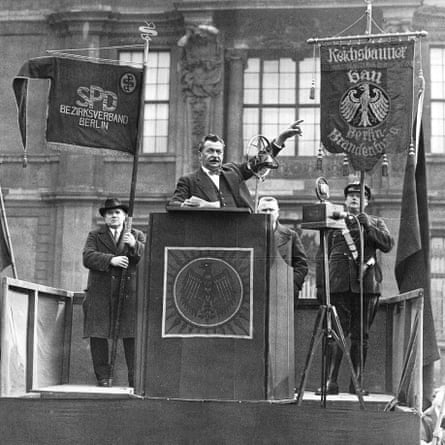
Among German historians, this has long been the dominant theory to explain the Nazi party’s success: that Hitler had an irresistible inner aura that captured the masses. There’s a second theory that is very similar, the führerkult idea. It argues that the NSDAP was so irresistible because it had a leader that spoke to Germans’ yearning for authoritarianism. The problem is: I couldn’t find any evidence before the 1930 vote to support those theories. Because in 1930, every party was practising a star cult around their own political leader, even the Social Democrats. The Nazi party didn’t have a USP in that respect. And the Nazis didn’t even seem to be wholly on board with the führer principle themselves at this stage. Several people in the party complained about the “Byzantine” star cult around Hitler, which is also why the campaign wasn’t really tailored around him as a personality. Let’s remember that in 1930 Hitler wasn’t even on the ballot, because he wasn’t a German citizen: he was a foreigner who had a criminal record for trying to mount a coup and was at risk of being deported.
I had grown up seeing Hitler as a monster, but one with a certain political talent. And after 1930, that’s not entirely untrue. But when you focus on 1928 to 1930, even his biographer Ian Kershaw concludes that the NSDAP’s success had very little to do with Hitler. He was going through an absolute dip in form. He only held 29 speeches in 1929, half of what was customary, and 21 of them were all in Bavaria. In 1930 Goebbels spent half the year complaining about Hitler’s prevaricating: when he travelled to Munich to track down the NSDAP leader, he didn’t even bother looking at the party headquarters. “The Reich leadership is at [Hitler’s favourite coffeehouse] Café Heck or the cinema,” Goebbels wrote sarcastically. In 1930, Hitler wasn’t a political genius. He was a lazy criminal who slept in until noon.
If not Hitler, was propaganda chief Goebbels the key figure behind the rise of the Nazis? One explanation being revisited these days is that political crises tend to go hand-in-hand with media crises: that the Nazis pounced expertly on new forms of media like illustrated news, radio and film.
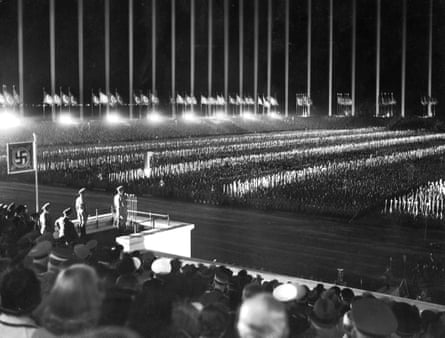
When we talk about the Nazis, everyone has these images in their head that point to this slick propaganda machine: the Nuremberg rally, the cathedral of light, all these awe-inspiring spectacles. And it’s true that pre-1930 Goebbels invested a lot of effort into building up propaganda newspapers inspired by American formats, such as Der Angriff, Völkischer Beobachter and Illustrierter Beobachter. But early Nazi propaganda was an embarrassing, amateurish joke. I’ve looked through every edition of Illustrierter Beobachter, and the images they presented to the reader were laughable, such as SA men dressed as advertising pillars. It just wasn’t professional. The sales figures were pathetic: nobody was reading these newspapers. Compare it to the means that the other parties had at their disposal: they put up neon signs on street corners and hired planes for aerial advertising. Propaganda just doesn’t explain the NSDAP’s success.
What about the economy? The stock market on Wall Street had crashed a year beforehand, German exports were collapsing and unemployment was on the rise.
It’s always tempting to fall back on economic factors when explaining the rise of fascist movements. We are hearing it again in Germany now: the economy is crumbling, the trains aren’t running on time, so people are going to fall for the fascists again. But if I look at historical sources from the run-up to 1930, I come away thinking that voters weren’t that stupid. Take the unemployed. Over the last 30 years, historians have established a pretty good picture of who voted for the NSDAP. And we can say with certainty that in regions where unemployment was high, the Nazi party performed relatively poorly. If anything, unemployment was a factor contributing to anti-fascist resilience. And as to the idea that the Nazis managed to attract young first-time voters, the same applies: the NSDAP also performed badly in areas with high rates of first-time voters. The young were also running away from this party.
The global economic crisis may explain why the NSDAP managed to double its support in 1932 and attain 37.3% of the vote. But as an explanation for the ninefold boost in 1930, it falls short. Wall Street’s Black Thursday didn’t fully arrive in Germany until July 1931, when several major banks collapsed – 10 months after the Nazis got 107 seats in the Reichstag. The Weimar Republic’s GDP went into a tailspin, with a 36.6% collapse, only over the course of the two years that followed – by the end of 1930, it had merely shrunk by 7.1%, and we don’t know how much of that was as a result of the election outcome. There’s a risk here of confusing cause and effect.
What if we look at the democratic parties instead?
One of the central tenets of the Nazi party’s campaign was the alleged corruption of the established parties, but there is very little evidence that this was actually the case. The most striking – and also the most puzzling – thing I learned was that all of the three big rightwing parties of the Weimar Republic had put political hardliners in charge between 1928 and 1929. If voters had really been desperate for tough rightwing policies, they could have voted for the Catholic Centre party, the nationalist liberal DVP or the monarchist DNVP – all parties in a pole position to turn their promises into practice.
Didn’t they just experience what many conservative parties are finding out now: that when they copy the positions of the far right, voters tend to prefer the original?
I think that’s a platitude that simply isn’t true. Because in 1930 Hitler wasn’t the original, he was a washed-out copy of what was offered by the DVP or the DNVP. The DNVP ran a more antisemitic campaign than Hitler, and yet it was the biggest loser of the election, shedding 7.3% of the vote. What strikes me as much more important is credibility. In 1930, the nationalist-liberal DVP was attacked by its own party newspapers for betraying the legacy of its former leader Gustav Stresemann, who had died a year earlier. It’s not unlike the situation we now have with Germany’s Christian Democrats: a party that under Merkel was absolutely centrist and managed to retain loyal voters but then picked a figure from its right wing as their new leader in Friedrich Merz. And voters are switching to the AfD. The central lesson to me is that conservative parties can only win from the centre.
You say credibility is key. Then why do corruption scandals barely seem to hurt the modern far-right parties railing loudest against ‘the system’?
It’s true that the NSDAP in 1930 was absolutely riddled with scandals: back-stabbing, power struggles, corruption, the whole spectrum. And many German journalists at the time believed they were just one more scandal away from complete collapse. There were some excellent and brave journalists leading some really good investigations. But it didn’t work.
I look at far-right parties across Europe now, and I see undercover reporters revealing the AfD’s remigration plans, leading to the biggest protests in postwar German history. And these kinds of investigations are extremely important. But fascist or rightwing extremist parties seem to be immune to this kind of stuff. They are like lightning rods: the scandal is a flash of energy that passes straight through them into the ground and then it’s gone. A corruption scandal might temporarily damage a party, like the “Ibiza affair” did to the Austrian Freedom party, but five years later they are back at double their strength.
So why did the Nazis perform so strongly in 1930?
As paradoxical as it sounds, it might be for the same reason that voters turned away from the Nazis in 1928: its propensity to violence. Ever since Hitler had been in the NSDAP, he had talked about one thing: executing his political opponents. And the Nazi party remained absolutely consistent in that respect. In the run-up to the 1930 vote, it didn’t talk about social policy, it didn’t talk about building the autobahn. It just had murder plots.
How does that help us understand the rise of fascist or rightwing extremist movements today?
It’s hard to admit this from a modern perspective, but historical fascism’s lust for violence didn’t make it repulsive but extremely attractive to a lot of German voters. And we are seeing similar things with the AfD today, where fantasies of violent retribution seem to be integral to campaign events on market squares. We are witnessing the poisoning of an entire society, and as a democracy we should ask ourselves whether criminal law shouldn’t apply when political parties communicate that way. Communication is one thing, political plans are another. The NSDAP had both. But we know that the AfD is a radical party that seems to want to ethnically cleanse Germany. If the AfD is voted into power, one of the most highly advanced economies in the world could experience something similar to what happened in Bosnia and Herzegovina.

Nessun commento:
Posta un commento